


Few capital investments are more visible than a new campus, school, or facility. Yet the experience of a place is shaped by more than architecture alone – it also depends on whether people know where to enter, where to go, and how to move through the environment once they arrive.
That makes wayfinding more than a finishing touch. When considered early, it can support circulation, make public access easier to understand, and create a positive first impression.
What Effective Wayfinding Delivers
Effective wayfinding begins with the user journey. Who’s visiting the site? Where will people need guidance or reassurance they’re headed in the right direction?
Answering those questions establishes clear priorities before any sign is designed — and often reveals that the most effective wayfinding systems don’t identify everything.
Not Everything Needs a Sign
Departments will naturally advocate for their own spaces, be it a lab, a breakroom, or a specialty program area, each mission-critical within its context.
But efficient systems emphasize the destinations that matter most to first-time visitors:
- Entrances
- Reception
- Event venues
- Vertical circulation
- Restrooms
Planning workshops give stakeholders an opportunity to harmonize those priorities — including fundamentals like destination names. A single room, for example, may have three different names depending on who you talk to. To determine what warrants signage, leadership first needs to come to a consensus on terminology — defining how the organization presents itself to the public.
A shared vocabulary carried across websites, printed materials, and internal communications promotes greater consistency for the public.
Planning Around the Journey
When factored in during programming, wayfinding shifts from a standalone graphic exercise to part of the overall planning process.
At the site level, monument signs and arrival markers can be coordinated in tandem with landscape, vehicular circulation, and pedestrian movement. A sign intended to be read at driving speed, for example, needs both a clear sightline and enough physical space to be legible before a driver reaches the next decision point. This reinforces key approaches and helps the arrival sequence read as a whole.
Inside, architects can anticipate mounting conditions and structural backing, while interior designers can balance placement with finishes, lighting, and materials.
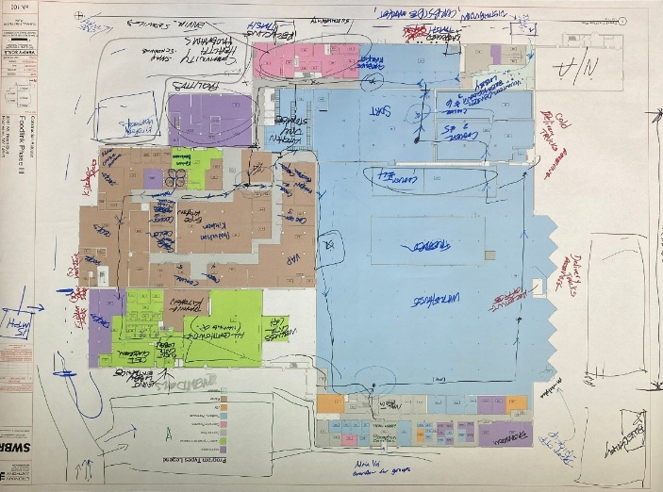
For Foodlink’s Production & Distribution hub, wayfinding begins with mapping client arrival, volunteer movement, and distribution flow. Those patterns inform the signage strategy for an intuitive experience on day one.
This co-creation between A/E experts and graphic designers helps guarantee a system that feels integrated with the building and authentic to how people use it. The outcome isn’t necessarily additional signage. Usually, it’s less — with each element positioned where it can be most effective.
Three Steps to Get it Right
- Assign Clear Ownership. Wayfinding calls for governance, so project leads should rally an objective decision-making group that can gather input while focusing decisions on true user needs rather than individual preferences.
- Define the Hierarchy. Agree on primary destinations, terminology, and audience priorities during programming.
- Design for Longevity. Identity evolves faster than buildings. Future-proofed signage (avoiding overly-embedded logos or brand colors) is paramount, allowing systems to adapt over time without reinstallation.
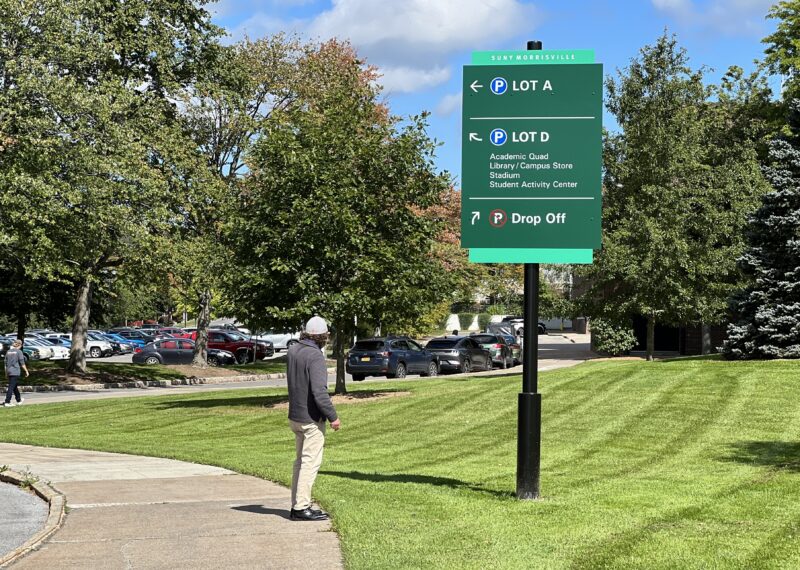
At SUNY Morrisville, directional signage guides visitors to campus parking areas and key destinations for streamlined arrival.
Clarity is a Capital Decision
The influence of wayfinding extends well beyond signage. For superintendents, easier navigation builds parent and community confidence. For developers, it impacts how prospective tenants perceive a property. For property managers, it minimizes exposure to rework and unnecessary lifecycle costs.
Ultimately, effective wayfinding is an indication that a place has been designed for what’s most important – those who use it.