
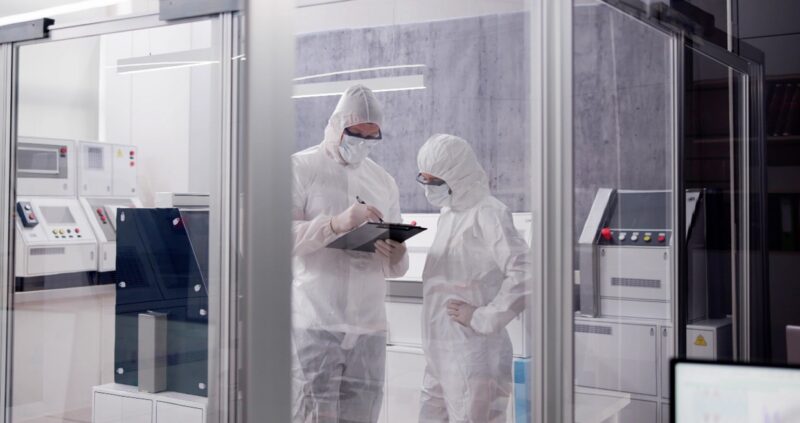


Facility planning often begins at a distance, through standards and owner’s descriptions of processes that are anything but static. Although those tools are necessary, the most successful project teams take an extra step: cultivating a firsthand understanding of how the technology actually unfolds.
For owners, operators, and lab directors, the opportunity is simple. Before initiating any design, determine the full scope of activities and requirements the space must support.
Rethinking “Programming First”
Programming remains foundational, but on its own can flatten conditions that are inherently dynamic. Benchmarks imply similarity where meaningful differences may exist; equipment lists capture what’s needed, but not how it’s used; square footage targets establish scale, but not interaction.
What ultimately drives performance are the moments where people, materials, and systems intersect. When design teams move beyond abstraction and engage directly with operational workflows, programming becomes more precise. Metrics gain context and problems come to light while there’s still time (and flexibility) to address them.
Experiencing Your Lab: What We Can Learn
Clarity is born from immersion in the most literal sense. That may look like architects and engineers walking an existing clean room fully gowned or observing a technician through a 12-hour shift to learn how materials travel or fall out of sync.
From within the lab, subtle details take on outsized importance:
- Airflow across a table
- Lighting that causes eye strain or error
- Extraneous reach or lifting of heavy tools by hand
Patterns also begin to emerge:
- Gowning sequence variations that impede process efficiency
- Clean and dirty paths competing for circulation
- Waste streams that interfere with production
Equally telling are the informal “band-aid” fixes teams rely on if space doesn’t match mission. Over time, these become the norm, masking deeper inefficiencies.
For example, while renovating a manufacturing facility, our team shadowed an operator inside a Class 1000 cleanroom. Wearing full personal protective equipment (PPE) made environmental hurdles immediately apparent: airflow from over-designed, clogged HEPA filters created unexpected turbulence, and warm temperatures were physically taxing over hours of work.
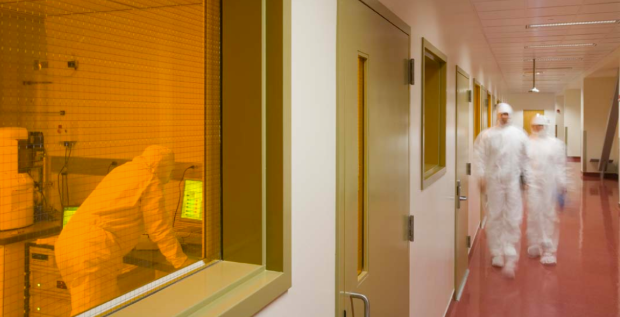
We also learned that parts were assembled at opposite ends of the lab, causing constant cross‑traffic, and gowning protocols were bypassed because the floorplan made compliance (like removing Tyvek suits to enter a break room) impractically time-consuming.
With underlying issues revealed and endured in real time, our team reconfigured the layout into a cohesive U-shape — improving ergonomics and reclaiming usable space without expansion. A cleanroom breakroom with specified limitations was introduced to support expedited access from within the environment.
Process Visibility as Problem Prevention
More than a “nice to have,” early immersion is a form of risk management. Projects rooted in lived experience can better anticipate:
- Safety conflicts tied to circulation and segregation
- Productivity losses from backtracking and congestion
- Sensitive adjacencies between clean, hazardous, and support zones
- Overbuilt or misaligned mechanical, electrical, and utility systems that don’t reflect actual demand
Lessons learned translate directly into proactive design choices: think where gowning should occur, or whether shell space can accommodate future expansion. The result is enhanced consideration for future renovation needs, fewer late‑phase change orders, and reduced capital investment.
Form Follows Physics
Facilities supporting fusion, laser, or advanced optics research are defined as much by geometry and physics as by planning logic. Beam length, convergence requirements, and radiation thresholds can determine building organization long before floor plans are discussed.
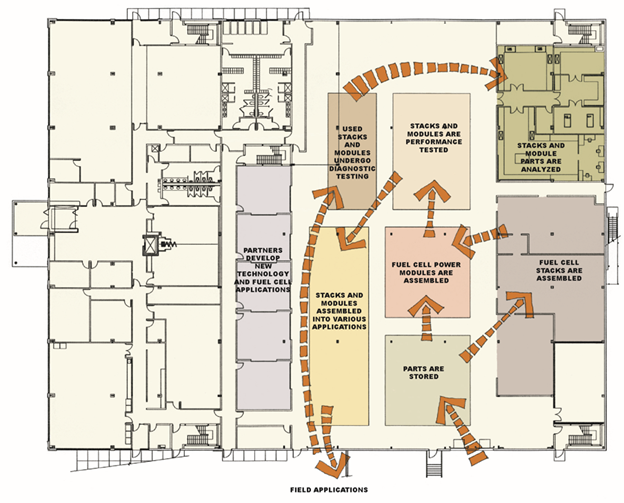
We typically begin by mapping the path and behavior of energy itself. In stepping back to examine how lasers needed to align and operate three dimensionally, we can identify alternate solutions that maximize efficiency and preserve performance. This demonstrates the importance of process-driven thinking, where a firm grasp of the science enables assumptions to be challenged rather than allowed to become constraints.
When to Start & Where to Focus
Immersion should begin ahead of programming. Project teams don’t need to become Principal Investigators themselves, but they do need to come prepared with thoughtful questions to anticipate downstream implications.
This process is iterative:
- Listen as end users explain their work
- Witness workflows in context
- Test assumptions through modeling and research
- Return with targeted follow-ups
- Repeat until comprehension replaces speculation
- Obtain approval from all relevant interest holders
Not every workflow calls for the same level of scrutiny. Priority should be given to systems with greater variability or dependency: hazardous materials, cleanroom transitions, vibration and radiation, stringent environmental tolerances, and high-frequency movement of people or equipment.
These conversations usually highlight additional site considerations, from soil behavior and plume migration to nearby traffic, informing smarter decision-making from the outset.
Design Begins with Perspective
Companies rarely struggle for lack of talent or ambition. They encounter friction when highly capable, brilliant teams inherit spaces that don’t support how they work.
You can’t out-design misunderstanding, but for project teams that invest time in seeing the work clearly — walking it, questioning it, learning from it — design becomes a natural extension of insight. Start with the process, and the building falls into place.