
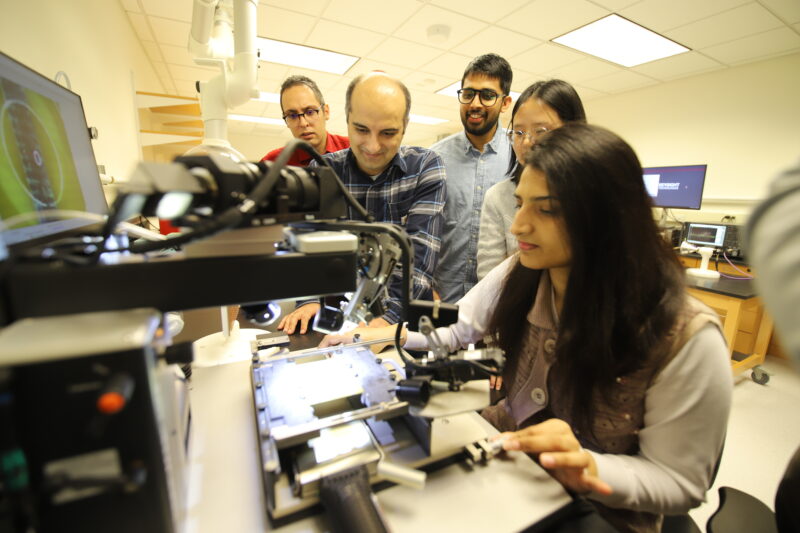

Photo courtesy of Syracuse University’s College of Engineering and Computer Science.
If organizational habits at your institution are feeling a little more malleable, you’re not alone. Compared to where we’ve been, colleges and universities are more open to updating processes and developing new operational models. Driven by the need to operate more efficiently, deliver greater value, and produce tangible outcomes, for many institutions change is no longer optional.
But even with this mindset shift, and escalating pressures, some complex challenges that cut across colleges, departments, and reporting lines can still get stuck. For many institutions, one of those cross-cutting challenges is how to manage their STEM portfolio more efficiently. It can be one of the most complex enterprise-level operational and capital cost centers to optimize.
Recruiting and research productivity are foundational to rankings and reputation, student experience, and central to the mission of serving people and planet. If you’re feeling a shift, have similar challenges, and are sensing an opportunity, it might be time to propose a new process with systematic impact.
The 80/20 Model
The model helps address:
- Growing research without new construction
- Facilities that do not compete well with peer institutions
- Lab renovations that take too long
- Overly individualized lab design
- Limited support for small research projects
- Aging infrastructure
The concept is built on two ideas. First, by type, 80% of research facility needs are the same – a strategy for aligning building systems with research program. Second, a delivery model – 80% of a lab renovation can be completed using predetermined lab typologies rather than being driven by specific research focus areas. While this portion of the work is the slowest and most expensive part of activating a research lab, it often has little to do with the specific needs of the research team. Despite calling it 80/20, in practice, the percentage rarely reflected actual time or cost – most often the “80” was even higher.
What Changed
From the time Planning, Design and Construction was notified, including approvals, lab renovations typically took 12 to more than 24 months. In many cases, this approach reduced lab activation by over a year, allowing faculty to be productive by the end of their first semester. What began as a method to accelerate research lab delivery became much more. It became our shared language and framework for enabling research infrastructure to elevate productivity, collaboration, and guide investment decisions.
You may choose to call your version of this model something different, but this strategy shouldn’t be confused with “plug and play” or other adaptable lab planning approaches.
The 80/20 model starts long before a design consultant ever enters the picture. While I’ll share the design principles we used to optimize buildings as part of this series, the real innovation was a new approach to managing the lab development process itself. One that helped academic leadership see their assets differently and gave them the tools to be able to leverage space more efficiently, often within annual operational budgets.
Start with Curiosity
Building a new process can feel intimidating. If you’re unsure how open your organization may be to new processes, especially one with this many connections and overlaps, start by holding a mirror up to your current practices. No ulterior motive, just curiosity.
Map your current process. The entire life cycle and ecosystem of how your STEM facilities program operates.
If that feels too big, start with a single new experimental, hard science faculty hire. Try it with someone already hired so you can trace real interactions and decisions. That one example will highlight important steps, and gaps, bringing visibility to how things are managed today. Sometimes small steps can activate broader change.
You’ll likely need to step outside your department, so consider teaming up with a colleague in another. Start at the very beginning, as early in the process as you can. You may gain insight into academic planning earlier than you ever have before. Map every touchpoint that brings that faculty line to life: every approval, every step, all the checkpoints that are defined by institutional strategy, research focus areas, school & college growth plans, and departmental aspirations. Document the full hiring process for that new faculty including being introduced to colleagues working in compatible research areas, common needs, and interests.
What Comes Next
While managing an R1 STEM facility portfolio, we faced many of these same challenges. We created new organizational habits through a research lab optimization model — an approach that might help you build your own.
In the next installment, I’ll share the key steps that worked for us – how we defined common terminology, what worked, what didn’t, and practical steps you can take to transform the way your institution manages its STEM facilities. I’ll walk through how the model translates research focus areas into activity, lab type, then infrastructure tier, and why defining your institution’s “product line” helps streamline planning and design decisions, and consultant engagement – including where and how the “20” fits in.
Before 80/20, every lab was a snowflake. Afterward, most fit within a defined product line.
Bruce Molino served as Associate Director, Campus Planning, and Director of Strategic Initiatives and Space Management for the College of Engineering and Computer Science, both at Syracuse University. He now leads Higher Education Strategy at SWBR.