
As one of only 460 reporting AIA 2030 Commitment Signatories in the U.S, our team annually benchmarks project performance, tracks progress toward decarbonization goals, and uses data-driven design strategies to help clients reduce energy consumption, lower carbon emissions and operating costs, improve resilience, and create healthy, high-performing buildings.
Our growing body of information helps to answer a critical question: What design strategies deliver the greatest impact?
What 72 Projects Are Telling Us
In 2025, 72 reported projects achieved an average 57% reduction in Energy Use Intensity (EUI), our best performance to date.
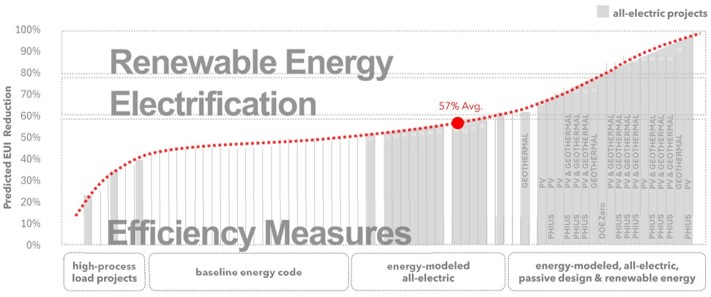
More than half incorporated energy modeling. Thirty-five used all-electric systems, 18 included solar PV, 13 incorporated geothermal, and 11 pursued Passive House certification. This work confirms that the most productive path to low-carbon and net-zero buildings utilizes a common formula:
- High-performance enclosure design
- All-electric building systems
- On- or off-site renewable energy
Integrated energy modeling and cost analysis efforts help teams evaluate those strategies and determine where investment brings the greatest impact on performance and long-term value.
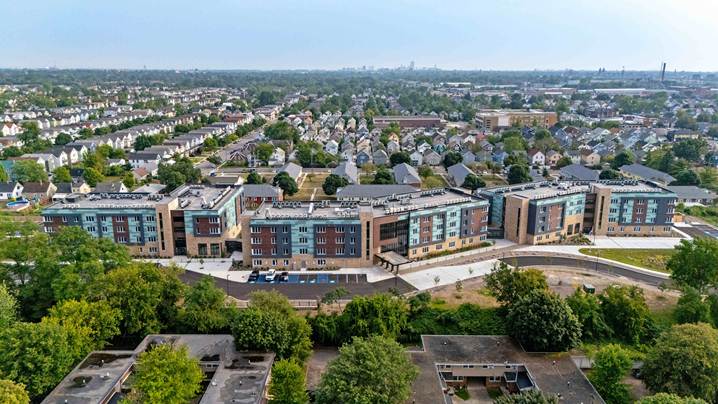
DePaul’s Pan American Square exemplifies this in practice. The affordable housing development achieved PHIUS+ Source Zero certification and net-zero operational energy by combining an efficient enclosure, all-electric systems, and renewable generation – offering low, stable energy costs and a healthy, supportive environment for those that need it most.
The underlying principle is straightforward: the less energy a building requires in the first place, the easier it becomes to meet the rest of its demand with cleaner sources.
Start With an Improved Building Enclosure
An enclosure with improved insulation, air sealing, glazing, and thoughtful detailing can significantly lower heating and cooling needs, reducing mechanical equipment demands.
The rewards extend beyond efficiency. Decreased demand can support smaller mechanical systems, more consistent indoor temperatures, improved acoustics, resiliency in extreme weather, and more predictable utility expenses.
Once heating loads are minimized, the transition to all-electric systems can eliminate on-site fossil fuel requirements, positioning facilities for continued decarbonization as the electric grid continues its transition to cleaner energy sources. A project’s incorporation of on- or off-site renewable energy can further reduce its electrical demand and offset any remaining fossil fuel consumption.
The Value of Early-Stage Energy Modeling
We see a direct parallel between the number of high-performance projects across our portfolio and the number of projects that utilize energy-modeling during design.
Energy modeling simulations identify the most cost-effective path to a high-performance, low-carbon design and help projects optimize first costs and reduce operating expenses with greater confidence. Early-stage energy modeling efforts can align the entire project team around integrated design strategies and more effectively inform construction cost estimates.
Perhaps most importantly, early analysis can be iterative – testing ideas and answering critical questions, including:
- Which wall, roof, and window assemblies perform best?
- What is the cost and benefit of additional insulation?
- Can a different glazing strategy or specification bring value?
- What HVAC system achieves the lowest operational carbon emissions?
- How much renewable energy is required to support a project’s target?
Early energy modeling helps project teams make informed design decisions before they become costly to change, reducing risk while uncovering opportunities to improve performance, lower carbon emissions, optimize system sizing, and control long-term operating costs.
Our Data Results in Better Outcomes
AIA 2030 Commitment reporting sharpens our understanding and helps us consistently produce better outcomes for clients seeking to reduce operational carbon, improve resilience, control long-term energy costs, and create healthier environments for the people who use their buildings every day.