
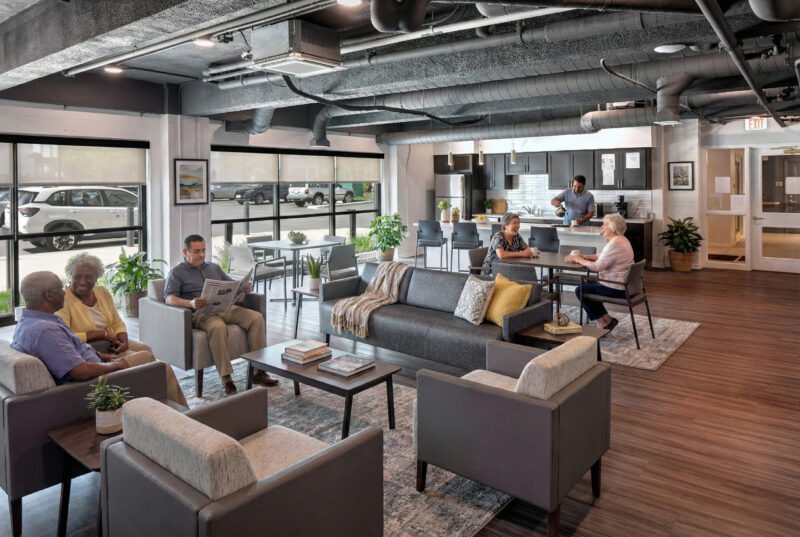

In housing, budget conversations typically begin with a familiar question: How low can we set the budget?
It’s understandable. Affordable and supportive housing developers, along with market-rate owners, face constant pressure to stretch limited resources further. Every dollar saved can feel like an opportunity to build more units or close a financing gap.
But cost alone is an incomplete measure of value, overlooking something equally critical: the experience and dignity of the people who will live in the building. A more useful question is: With the budget we have, how much can we give residents?
Spend Where People Feel It
A key to stretching the budget is understanding that not every part of the building demands the same level of visual impact. When visitors are wowed by a building, it’s often the moment of arrival that shapes their perception.
It may be helpful to think of housing design as a heatmap. Where will most residents and visitors interact with the building? Which spaces shape the life of nearly everyone who enters, vs. only a handful of people?
Consider the resident journey:
- You enter the front door.
- You move through the lobby.
- You pass artwork, neighbors, and community lounges.
These moments form an impression long before anyone reaches their apartment, because entrances and shared gathering spaces belong to everyone. Subconsciously, “ours” becomes part of “mine,” growing a resident’s sense of “home” beyond their apartment to include the entire community. Even a recognizable picture of a local landmark or a nook where neighbors naturally pause can help a building feel connected to both its residents and surroundings.
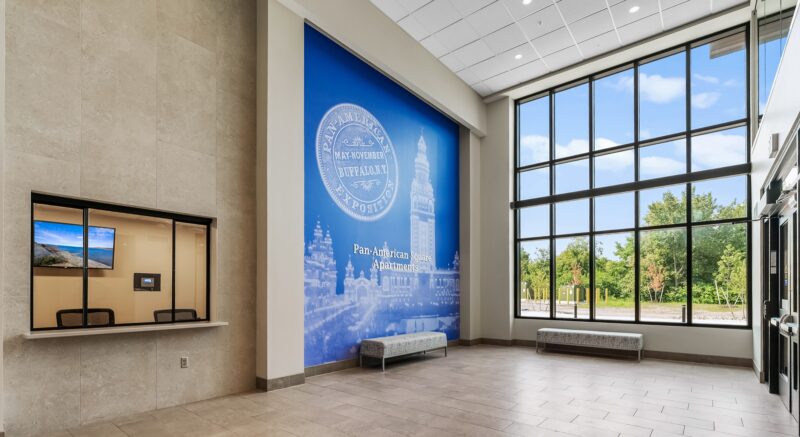
The lobby at Pan-American Square Apartments features a mural referencing the historic 1901 Pan-American Exposition (hosted in Buffalo), anchoring the campus within the city’s cultural narrative.
The idea isn’t to make one area beautiful and neglect the rest, but to understand where a stronger design move will be felt most broadly and where simplicity may better serve the project.
A Little Drama Goes a Long Way
“Wow factor” can sometimes be a misleading phrase because it suggests spectacle — something flashy enough for an award submission or a donor tour. Occasionally, that kind of statement is appropriate. More often, the smarter move is more subtle and cost-effective.
It may mean using a warmer material to signal an entrance, allowing one distinctive light fixture to carry a room, or varying standard acoustic panels in size and arrangement to create a more intentional composition. One thoughtful intervention can shape how the entire building is received without requiring premium materials everywhere.
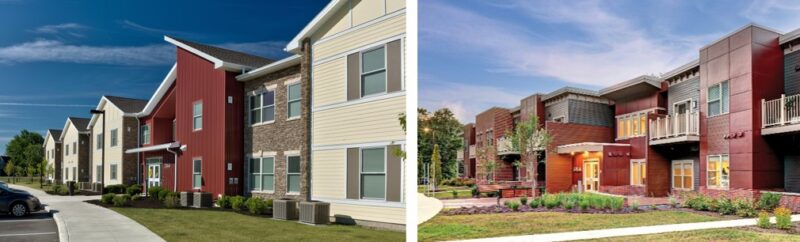
This philosophy carries across diverse projects. At Trolley Station Apartments, practical manufactured stone and fiber cement siding make up most of the exterior, while corrugated metal and storefront glazing concentrate visual interest at the main entrance. Similarly, Cobbs Hill Village uses higher-cost wood-look cladding and canal-lock-inspired elements to guide residents toward the building’s points of entry.
This applies at a smaller scale, too. Window trim, entry details, or carefully selected finish transitions may represent a relatively modest cost increase, yet have a disproportionately significant effect on how a building feels. Some of the first items cut during value engineering can be the very details that contribute most to a project’s character.
When You Have to Cut, Think Big
Of course, budget pressure is reality for nearly every housing project. Sometimes the team needs to account for a few thousand dollars, and other times, the gap is into the hundreds of thousands.
When significant savings are mission-critical, we shift our thinking from emotional impact to volume, looking for decisions that repeat at scale.
For instance, if every apartment includes a tile backsplash, could a cost-effective panel product meet the functional need instead? If one exterior material covers half the building, is there an alternative that changes the cost per square foot? Could a small adjustment to a repeated detail decrease labor across hundreds of installations?
The key is to establish the threshold you aren’t willing to cross. Materials can be simplified, substituted, or reduced, yet the design still has to perform, age well, and make sense when pencils are put down.
The “Cheapest” Option Can Get Expensive
One of the most common misunderstandings is assuming the lowest upfront cost automatically creates the greatest value.
Doors are a perfect example of this misconception: a hollow-core option may cost less, but in a multifamily environment, daily wear and tear adds up. When finishes deteriorate and repairs lag, the environment can begin to feel neglected, inviting a cycle of disrespect and damage. And if replacement becomes a recurring expense, ownership costs can ultimately exceed the initial savings.
On one recent project, unforeseen soil conditions consumed a substantial portion of the construction contingency before the building was out of the ground. To recover costs, the team evaluated alternatives to a metal cladding system covering a section of the façade.
Price was only the beginning of the conversation:
- Will the replacement material need to be repainted in five or ten years?
- What will it cost to repaint a six-story building?
- Will a larger-format panel flatten the façade or change its scale?
- Can another product preserve the durability, color palette, and much of the original design intent while still generating savings?
Those questions are the real work of cost management. A construction issue that lasts two weeks shouldn’t automatically lead to a material decision the owner will be managing for the next 30 years.
Dignity Is Worth Designing For
Successful housing projects shouldn’t be measured by how little was spent, but by how much human impact was generated by the investment.
Sometimes the right choice is to enhance an arrival experience every resident encounters each day; sometimes it’s to select a material that will withstand years of use with fewer repairs. Always, it means resisting the temptation to chase the lowest upfront price when it comes at the expense of performance or dignity.
Extravagance isn’t the goal. Every project should focus on delivering a place that feels considered, lasts longer, and gives residents a place they can be proud to call home.