
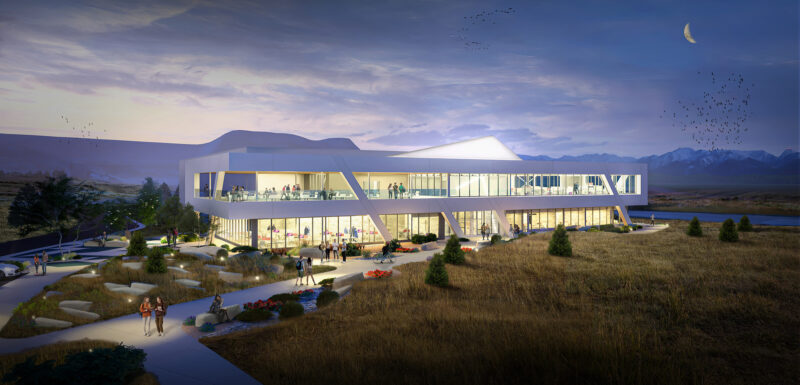

Before a single photon moves down a beamline, hidden structural and environmental forces are already impacting your data quality, uptime, and credibility. Successful facilities address these mission-critical forces in the earliest stages of planning — empowering owners to deliver reliable, high-performance science from day one.
The Two Families of Forces
A laser lab works like an optical table: mass, stiffness, and isolation safeguard experiments at microscopic levels. When you scale that responsibility to an entire facility, the physics don’t change, but the return on investment of proactive planning grows dramatically.
The components that drive this process fall into two groups: external and internal.
External Forces (Site and Structure at Work)
These variables originate beyond the facility, but act on the entire building. Imagine standing on a trampoline as someone drops a bowling ball onto it; everything responds. Railways, heavy-use roads, bridges, flight paths, and wind loading do the same to a structure; functioning as a giant instrument of a laser lab and informing:
- Foundation strategy
- Slab thickness and building design strategy
- Lateral drift limits
- Shielding
- …and overall construction costs
With high winds, structural performance needs can escalate quickly, and unknown subsurface conditions are equally harrowing. A site that looks ideal above ground may conceal soft clays, loose sands, or shallow bedrock that necessitate additional excavation or reinforcement — conditions that can swing costs by as much as 30%.

The Target & Laser Bay at Colorado State University’s (CSU) ATLAS facility needed to withstand native winds of 144 mph, up to triple what many research markets experience. Maintaining stability demanded a stiff structural lateral system to prevent wind‑induced drift from walking laser targeting out of position.
Internal Forces (the Quiet Disruptors)
These variables are born from the people and equipment within a building. If external forces are a bowling ball, internal forces are a mouse crossing the surface: subtle, yet enough to disturb ultra-fine work.
Common examples include:
- Footfall on surrounding slabs
- Mechanical harmonics from fans, pumps, and rotating equipment
- Air turbulence
- Pressure fluctuations along beam paths
Slower-acting patterns can also have an effect:
- Daily temperature changes that cause expansion and contraction
- Concrete slab creep and shrinkage that alter elevation over years
Internal forces aren’t inherently problematic, they just need to be calibrated to each lab’s required sensitivity.
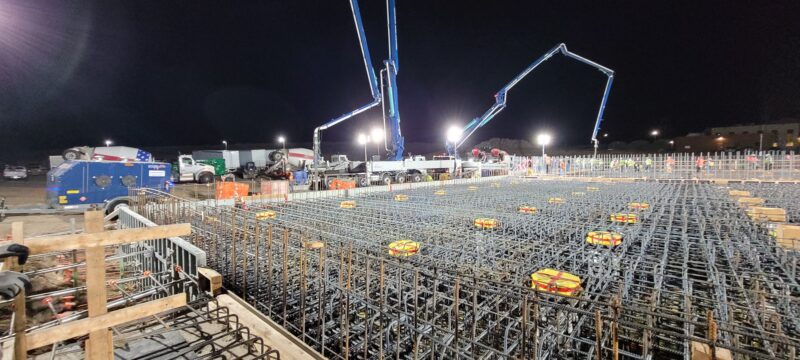
Pictured: Construction crews carry out a pour at CSU ATLAS – the project required over 3,000 cubic yards of concrete to create 60-inch-thick reinforced shield walls and a 46-inch reinforced slab.
Proportionality matters. With site and structural conditions thoughtfully balanced, the “optical table” reacts as expected. Tighter tolerances become an advantage, giving research teams more control so they can concentrate on improving data quality.
By Design or Default? 3 Pivotal Steps for Owners
A handful of leadership choices — besides drawings — help establish boundaries for price, schedule, and structural direction.
1. Choose the Optimal Site, Not the Most Convenient. Site selection is often treated like real estate, but for a laser lab, it’s about performance engineering. When deciding on a location, owners should carefully consider the effects of traffic patterns; flight paths; native seismicity and wind exposure; and geological data.
Because these influences span miles, not just the few acres of a proposed parcel, early assessment is a powerful tool for cultivating future-readiness. A stable site keeps the design process efficient and affordable, paving the way for long-term operational excellence.
2. Anchor the Project in Shared Priorities. A successful project is rooted in alignment. Before architects and engineers begin design, leadership teams should come to an agreement on what fundamental programs, materials, and workflows the facility must support.
Start with objective clarity:
- What outcomes must the science achieve?
- Which experiments are most stability-dependent?
- What risks to personnel flow, data, or reputation are acceptable?
Then explore space implications:
- What space/function absolutely requires the highest level of structural design and vibration performance?
- What space/function can be adjacent but isolated?
- What space/function belongs outside the core envelope?
This understanding creates a cohesive design framework that unifies decision‑making.
3. Assemble a Specialized Team Early. Front-end feasibility and site evaluation are where technical voices yield the greatest return.
Engage MEP, cleanroom, and structural engineers; geotechnical specialists; vibration and radiation consultants; construction partners; and industry leaders from adjacent research fields. These subject matter experts will help you validate assumptions and provide the insights necessary to make confident, data-driven choices.
The Bottom Line
The most consequential project outcomes are shaped long before construction, in selecting an appropriate site, defining clear goals, and involving seasoned consultants from the outset. This forward-looking approach transforms your facility into a true partner in discovery — enhancing precision and scientific value while helping researchers unlock new opportunities for decades to come.